|
Getting your Trinity Audio player ready...
|
A Race Through Open Terrain and Slot Canyons
Orienteering is always an adventure, but when you take it to the vast, open landscapes of the Anza Borrego Desert, it becomes something entirely different: a test of strategy, endurance, and navigation where both your brain and legs get a serious workout.
We signed up for two of the four events at the San Diego Orienteering Festival, each offering its own unique challenges. One tested our speed and strategy in an open desert, the other had us navigate a twisting slot canyon and a featureless plain. Both left us exhausted, thrilled, slightly sun-baked, mildly dehydrated, and more emotionally attached to our compasses than ever before.
Day 1: The Adventure Trek, Where the Desert is Silent
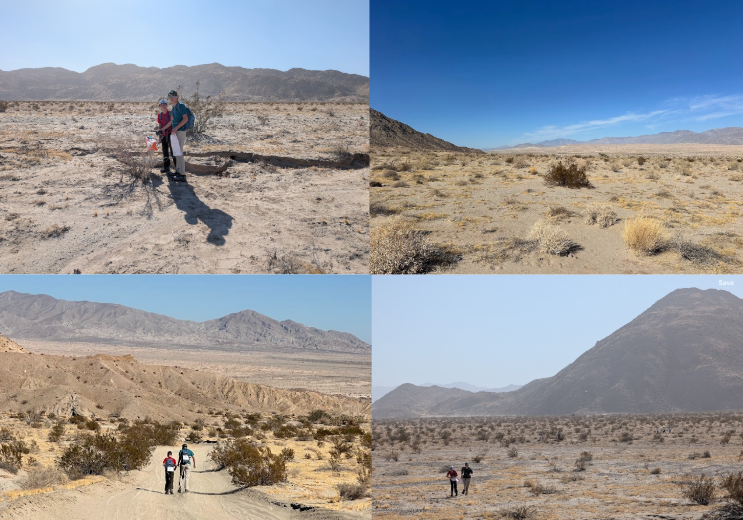
The first event was the Adventure Trek, a mass-start course designed for strategy and speed. But before the real action began, there was a warm-up: a two-kilometer walk from the event headquarters down to the actual starting point. That’s where I feel I should have earned a few extra points. Everyone ahead of me walked right past the start and straight into the wild unknown. I could’ve let them keep marching off into the desert like confident little lemmings, but I called them back, mainly because my husband and older son were two of them.
Everyone else who arrived afterward just followed the crowd already gathered at the right spot. But let’s be clear: I was the original lemming. If anyone deserved bonus points, it was me.
Not that it would’ve helped much, there were some true desert orienteering wizards out there who could practically smell control points from 500 meters away.
Into the Sea of Silence
Shortly before noon, about 170–200 participants gathered at the starting line, with maps and compasses in hand. At exactly 12:00 PM, we took off, sprinting down a dirt road and into what they called the Sea of Silence, a vast, open space of sand and scattered brush with a few hills and rocks here and there.
With very little man-made structure in sight, it was all about map, compass, and calculated guessing. Fortunately, a few dirt roads provided some reference points; otherwise, it was just miles of nothingness and the occasional sinking feeling that you might not be where you think you are, sometimes quite literally, as your foot disappeared into a hole left by a very ambitious desert bunny.
Strategy, Lemmings, and Bunny Holes
The course had 24 control points, each worth 1 to 5 points based on difficulty and distance. We had two hours to collect as many as we could. Go too far and you waste time; play it too safe and you miss the big points.
Our family split up. My husband and kids bolted off with boundless energy, while I took a more measured approach, step counting, visual cues, and an ongoing awareness that the desert is basically a minefield of bunny-sized ankle traps.
Thankfully, the control points weren’t hidden, you could spot their bright orange-and-white markers if you looked carefully. And if not? Sometimes the best tool is just following the crowd, because if a group of lemmings is running toward something, they’ve either found it… or are about to get very lost together. Either way, that’s strategy.
Then there were the pros, the ones who seemed to glide across the sand like it was a treadmill set to “cruise,” spotting control points from way off in the distance. No sinkholes for them. Just speed, precision, and unnaturally stable ankles.
The Dust Trail Escape Plan
Toward the end, my husband and kids almost lost each other, and missed the cutoff time by a few minutes. They came in with a group of others, and racked up some penalty points. At one point, I heard them over the walkie-talkies trying to navigate their way back, and let’s just say their conversation was… less than calming from a mom’s perspective. Thankfully, I heard my husband tell them to “follow the dust trail” of a car that had just passed me on the dirt road. That oddly specific instruction was, bizarrely, the most reassuring thing I’d heard all day.
Day 2: The Maze Middle Course
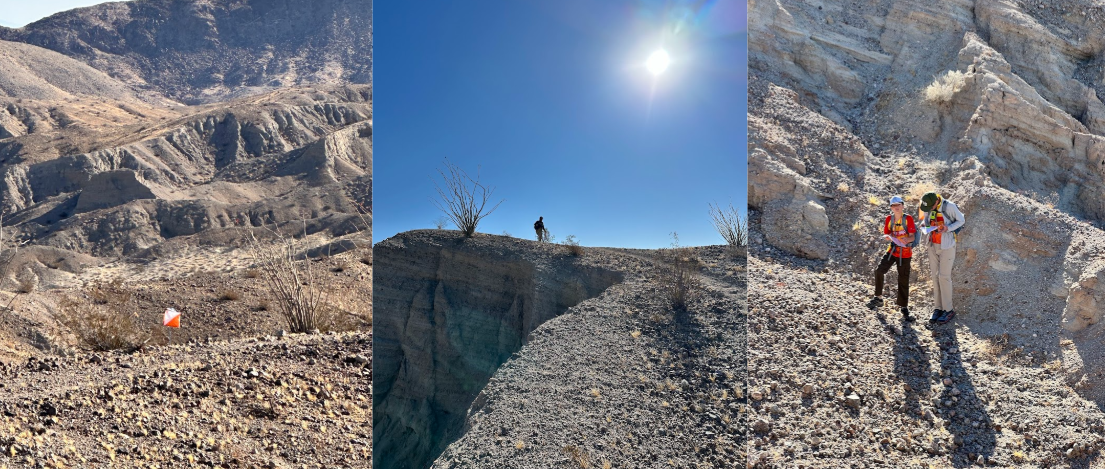
The next morning brought a completely different kind of challenge. the Maze Middle, set among Anza Borrego’s stunning slot canyons. Unlike the chaotic mass start of Day 1, this event had staggered start times, with racers heading out every two minutes.
I started first in our family but was quickly overtaken by both of my boys. My husband made sure I didn’t get permanently lost in the canyons, but once we hit the open terrain, they vanished again like desert mirages.
Courses were divided by difficulty: white and yellow for beginners, and orange, brown, green, red, and blue increasing in complexity. We picked orange, challenging but still manageable. One added twist: not every checkpoint was for your course, so even spotting a control point didn’t guarantee it was the right one. You had to check the number and stay focused.
Into the Maze
The first five control points were tucked inside the slot canyons, a twisting labyrinth of narrow rock walls, steep drops, and sharp turns. Some trails helped, but overall, it was a game of precision. Unlike the open desert, where you could spot markers from a distance, here it was all about quick map reading and trusting the terrain.
Once out of the canyon, the course opened up again. Navigation shifted back to long compass bearings and careful pacing. It was just me, my map, my step count… and the hope I wasn’t slowly drifting into a parallel course.
Point Bathroom
Somewhere between control points 6 and 7, I spotted a tiny black square on my map, a bathroom, standing proudly in the middle of absolutely nowhere.
Forget strategy. Forget points. Forget step calculations. This was now the most important landmark in my orienteering career.
I marched toward it with purpose… only to find a line. Where had all these people come from? And why did they all suddenly need to pee in the middle of my race? Not ideal. Standing still during a race usually isn’t part of the plan.
Oh well. Mission accomplished, I rejoined the course, slightly lighter, slightly behind, and a whole lot more motivated.
Point 9, My Nemesis
One of the toughest parts of orienteering is second-guessing yourself. Just because you’re heading the right way doesn’t mean it feels right. And the temptation to check every post you see? A fast-track to total disorientation.
Point 9 should have been straightforward, but I kept spotting nearby posts and checking them. Not mine. Again. Not mine. Eventually, I had completely lost track of where I was. What should’ve taken five minutes turned into a 30-minute wandering session, with increasing doubt and decreasing dignity.
Meanwhile, my kids had already finished, probably inhaling snacks and debating their favorite control points while I was still out there, wondering how I had spent this much time wandering this much space.
When I finally found point 9, I didn’t know whether to cheer, cry, or apologize to it. I punched the e-stick like it had personally betrayed me and trudged off to the final two points and the finish line.
The Final Takeaway
Orienteering challenges both body and brain. It forces you to think on your feet, problem-solve under pressure, and stay calm when you’re halfway convinced you’re lost forever.
But when you get to do it in a place as wild and beautiful as the Anza Borrego Desert, all the sore legs, dusty clothes, and humbling detours somehow turn into part of the joy.
Would I do it again? Absolutely.
Would I train more next time? Yes, and hydrate more too.
Would I try to beat my kids? Let’s not get carried away.