|
Getting your Trinity Audio player ready...
|
What do meditation and AI have in common? At first glance, nothing! They seem like opposites, one ancient and inward, the other modern and outward. But their similarities might surprise you.
Summer of ‘99
It was the summer of endless studying. I was buried in biochemistry textbooks, preparing for exams, and pushing my brain to its limits. One night, after hours of reading, I collapsed into bed, only to find my subconscious continuing the study session in my dreams.
That morning, I had an exam, a migraine, and a brain that felt like mush. I remember staring at a question: How come the population of newborn babies is close to 50% boys and 50% girls? I didn’t know the answer at first. I remember thinking: even if the knowledge I need isn’t in my conscious mind, it must be out there somewhere, waiting for me to tap into it. But how? I stared at the wall, letting my mind quiet, and suddenly, the answer floated before me: Moms have XX chromosomes, and dads have XY, so there’s a 50:50 chance that dads pass on either an X or a Y.
That answer didn’t come from my textbooks, it felt like it came from somewhere deeper, a hidden reserve of knowledge that I’d somehow accessed.
Years later, when I first heard about AI’s ability to access and process vast amounts of human knowledge, I couldn’t help but think back to that moment. It felt like I’d experienced something similar long before AI was even on my radar, tapping into knowledge that seemed to exist beyond my conscious awareness.
From Encyclopedias to Instant Access
Back then, accessing information wasn’t as simple as it is today. Computers were just becoming common, and I think I was one of the first people in my class to have one. But even then, I didn’t know how to use it properly. Instead, we relied on encyclopedias, 12 big, heavy books my dad proudly bought for our family.
Having those encyclopedias at home was a luxury. They were a source of fascination, and we’d talk about them at the dinner table. But accessing them wasn’t instant. It was almost like a ritual: we’d have to wash our hands first and handle the pages carefully. I wasn’t home much that summer, so the encyclopedias were only available on weekends, a reminder of how accessing knowledge required both effort and intention.
Fast forward to today, and those encyclopedias feel like relics of another era. What once required flipping through indexes and cross-referencing pages now happens almost instantaneously. With AI, we can access the collective brainpower of humanity in seconds.
For my kids, this instant access is just a given. They’ve never had to wait to look something up or flip through an index, and they see no mystery in how the information appears. For them, it’s seamless, automatic, just there. But for those of us who lived through the shift, the speed and ease of AI still feel almost magical, like something from science fiction.
As I reflect on this, I see a fascinating parallel between the way AI grants us instant access to collective human knowledge and the way meditation opens the door to something deeper.
Accessing the Universal Database: The 5% vs. the 95%
Only about 5% of our brain’s activity is conscious, while the remaining 95% operates in the subconscious.
AI gives us access to the 5% of human knowledge that has been consciously documented and digitized. This collective accumulation of knowledge is incredible, but it’s still just the tip of the iceberg.
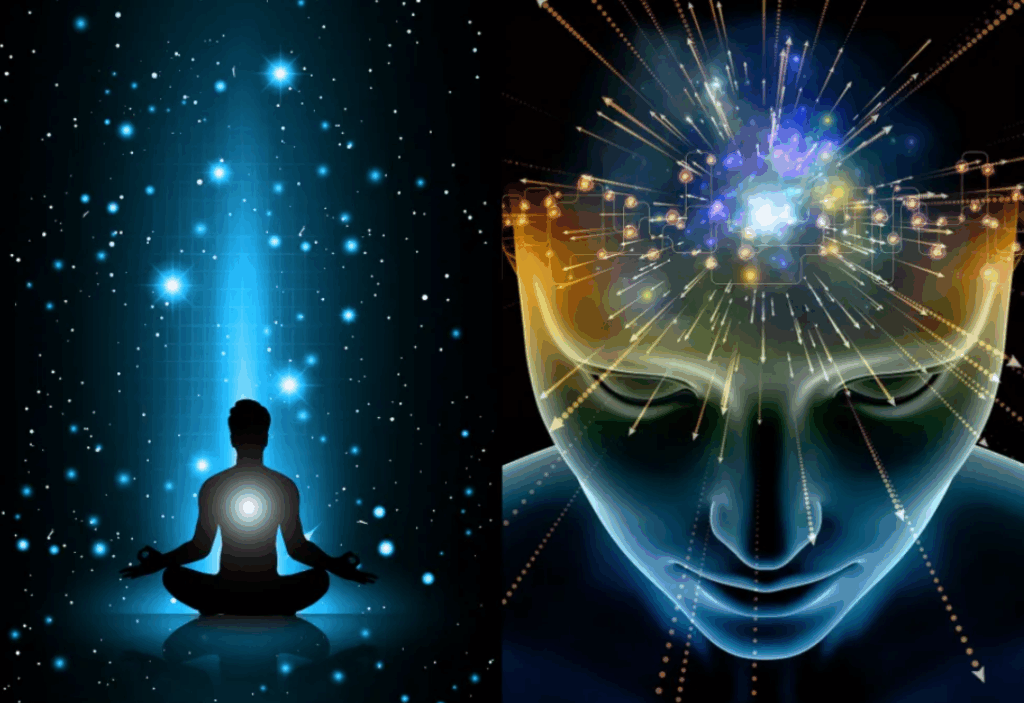
Meditation, on the other hand, takes us beyond the 5%. It connects us to the vast 95%, the subconscious, the soul, and even universal wisdom. It’s where answers come not from data but from clarity, insight, and connection to something infinite.
While AI looks outward, providing information and facts at incredible speed, meditation turns inward, guiding us to wisdom and understanding. Both tools, in their own ways, help us access something greater than ourselves.