|
Getting your Trinity Audio player ready...
|
I used to find words easily, whether in English, French, or German. If one language failed me, another one would usually offer the missing word. But lately, they weren’t just hiding in another tongue. They were gone. I could sense them hovering just out of reach, their shape and texture clear in my mind, only to watch them dissolve before I could speak.
As a biochemist, I had studied hormonal cycles, including their decline during menopause, in the tidy way textbooks present them: bullet points, neat charts, predictable stages. I thought I understood it. But when my turn came to step into that terrain, nothing about it was tidy. The theories I’d memorized became flesh and bone, my own flesh and bone, and I realized how little those diagrams had prepared me for the lived experience.
Later in life, when I discovered Traditional Chinese Medicine (TCM), something clicked. Through that lens, menopause isn’t a malfunction or a decline. It’s a seasonal shift in the body, a turning tide, a redirection of energy. And that changed everything for me.
Different Cultures, Different Menopauses
In conversations with other women in midlife, I’ve noticed a pattern. They talk about menopause the way one might read a medical chart: hot flashes, brain fog, sleepless nights, joint pain, weight gain. There’s a sense of resignation in their voices, as if their identity has been replaced by a checklist of discomforts. Many speak of “getting through it” the way you’d get through the flu, they endure it, medicate it, wait for it to pass. Rarely is there space to imagine it as anything but an interruption to life, let alone as a stage that might hold its own purpose or beauty.
The truth is, symptoms vary across cultures: in the U.S., around 80% of women report hot flashes; on the Yucatán Peninsula, almost none do. In parts of Asia, frozen shoulder is so common during menopause that it’s considered a main symptom.
I remember learning this in acupuncture school and being stunned. If symptoms can differ so much depending on where you live, then lifestyle, environment, and cultural framing clearly play a huge role. Menopause is not a fixed sentence. It can shift. We can shift.
The Seventh Seven: An Ancient Map of Women’s Lives
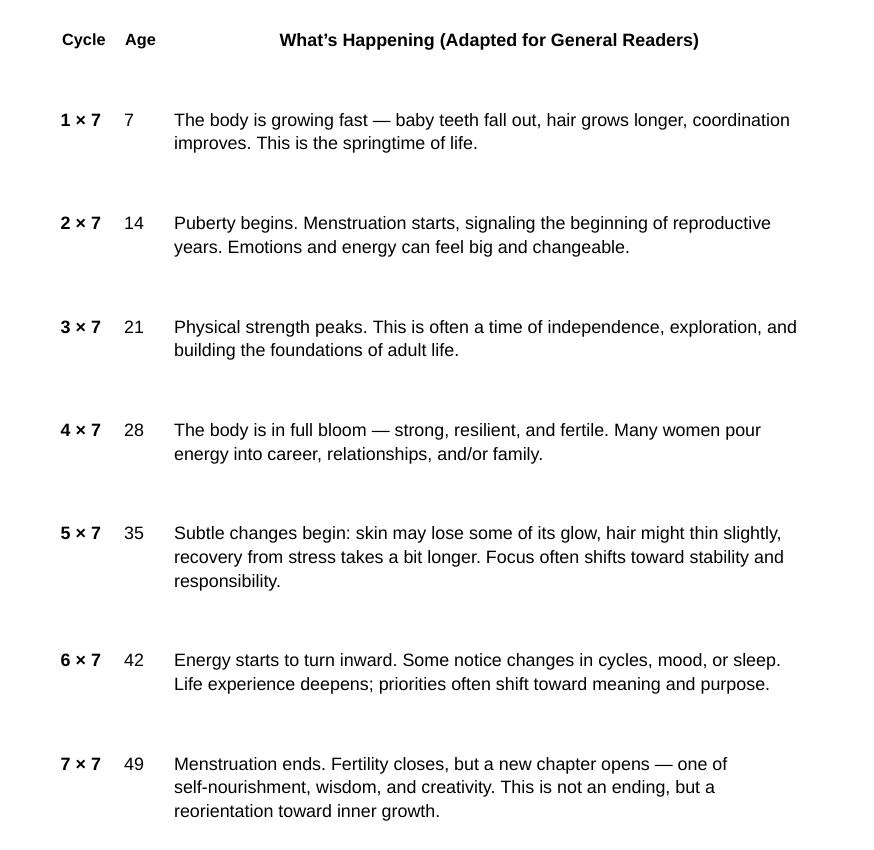
In the Huangdi Neijing, the foundational text of Chinese medicine, women’s lives are described in cycles of seven years. They corresponds to transitions like puberty, motherhood, and menopause, but there are more. And for menopause, at “seven times seven,” around age forty-nine, it says:
The tian gui, reproductive essence, dries, and the body’s great rivers, the Chong and Ren channels, begin to ebb. Fertility ends. This is not framed as a failure, but as the next stage in a lifelong rhythm. In Daoist thought, this is fan (返), the return, the reversal, the inevitable shift of energy back toward its source.
How Acupuncture Supports You Through Menopause
Menopause is often described through symptoms: hot flashes, anxiety, joint pain, sleep disturbances, brain fog.
But beneath those symptoms is a complex hormonal shift, and a very different story depending on whether you’re looking through the lens of Western physiology or Traditional Chinese Medicine (TCM).
Acupuncture regulates the nervous system and hormonal pathways (modern science), and it restores balance to Qi, Blood, Yin, and Yang (TCM).
In TCM, menopause isn’t a failure of the body.
It’s a transition point where certain systems naturally weaken, others overwork to compensate, and the entire internal landscape shifts into a new rhythm.
Acupuncture helps the body make that transition with more stability, resilience, and comfort.
Let’s break down how it works in a way that makes sense to Western patients, and what you can do at home to support the process.
1. How Acupuncture Helps Biologically
Acupuncture doesn’t “add hormones.” It helps the systems that regulate your hormones function more smoothly.
• It calms the stress response
High cortisol makes everything worse, sleep, hot flashes, anxiety, and belly weight.
Acupuncture switches your body out of fight-or-flight and into rest-repair mode, where healing and hormone regulation happen.
• It steadies the autonomic nervous system
This is the system that controls body temperature, night sweats, heart rate, and digestion.
Acupuncture improves temperature stability and reduces the intensity of hot flashes.
• It reduces inflammation
Lower estrogen → higher inflammation → joint pain, stiffness, migraines.
Acupuncture lowers inflammatory markers and improves blood flow, which is why many women feel:
“My knees hurt less and my mind feels clearer.”
• It improves sleep quality
Many menopausal symptoms become manageable once sleep improves.
Acupuncture helps regulate sleep cycles, especially the 2–3 AM wakeups connected to hormonal changes.

2. The Four Major TCM Patterns Behind Menopause Symptoms
Western women often think of menopause as one thing.
TCM sees different possible underlying patterns, each with its own symptom profile.
You may recognize yourself in one or two of these.
Importantly:
These are not “diseases.” They are descriptions of how your internal systems are functioning.
Think of them as the body’s “operational settings.”
For each pattern, I’ll give simple lifestyle practices that support the acupuncture process.
Pattern 1: “Kidney Yin Deficiency”
(The Overheated, Dry, Wired Pattern)
How it feels (in Western terms):
- Hot flashes and night sweats
- Dry skin, dry eyes, vaginal dryness
- Waking up at 2–3 AM
- Anxiety or irritability
- Low back or knee ache
- Feeling “tired but wired”
In TCM, “Yin” represents your cooling, nourishing, moistening, stabilizing resources.
When Yin is low, your nervous system overheats, leading to heat waves, dryness, and restless sleep.
Lifestyle support:
Eat cooling, hydrating foods:
- cucumber, watermelon, berries
- tofu, mung beans
- cooked greens
- soups and broths
Reduce internal heat triggers:
- alcohol
- caffeine
- spicy foods
- late-night eating
- over-exercising
Build Yin through rest:
- earlier bedtime
- restorative yoga
- slower, longer walks
- breathwork before sleep
This pattern responds beautifully to acupuncture, especially for sleep and night sweats.
Pattern 2: “Kidney Yang Deficiency”
(The Cold, Sluggish, Low-Motivation Pattern)
How it feels:
- Cold hands and feet
- Low energy
- Slow metabolism or weight gain
- Fluid retention
- Low mood, low motivation
- Waking up tired
“Yang” in TCM is your metabolic spark, your warmth, drive, and vitality.
When Yang is low, everything feels like it’s moving through molasses.
Lifestyle support:
Warm, cooked foods:
- oatmeal, soups, roasted vegetables
- ginger tea, cinnamon
- mild warming spices
Gentle strength-building exercise:
- hill walking
- slow strength training
- core stability and balance
Protect your warmth:
- avoid cold smoothies in the morning
- keep feet and lower back warm
- avoid sitting on cold surfaces
This pattern often improves metabolism, energy, and morning fatigue with acupuncture.
Pattern 3: “Liver Qi Stagnation”
(The Mood, Stress, and Sleep Rollercoaster)
How it feels:
- Irritability
- Mood swings
- Feeling “tense inside” or overwhelmed
- PMS-like symptoms even without a cycle
- Digestive issues when stressed
- Waking 2–3 AM
- Migraines or tight shoulders
The Liver in TCM regulates emotional flow, stress processing, and smooth movement of energy throughout the body.
When it’s stuck, stress amplifies all menopausal symptoms.
Lifestyle support:
Move gently but often:
- 20–30 minutes of walking
- dancing
- yoga flow
- anything that lets the body move rhythmically
Eat stress-friendly foods:
- leafy greens
- citrus
- mint
- chamomile
- cruciferous vegetables (support detox pathways)
Create daily emotional outlets:
- journaling
- talking with a friend
- creative expression
- breathwork or tapping
This pattern is the one most tied to emotional symptoms, and also the fastest to improve with acupuncture.
Pattern 4: “Phlegm-Damp Accumulation”
(The Brain Fog + Weight + Sluggish Digestion Pattern)
How it feels:
- Weight gain around the midsection
- Foggy thinking
- Low energy
- Bloating or slow digestion
- Fluid retention
- Feeling “heavy” or unmotivated
In TCM, this pattern is about metabolic slowdown and the body struggling to transform fluids and nutrients efficiently.
Lifestyle support:
Light, clean, whole foods:
- vegetables
- lean proteins
- soups instead of creamy foods
- avoid heavy, greasy meals
Reduce dampness-producing foods:
- excessive dairy
- sugar
- fried foods
- too many raw foods (they weaken digestion)
Add metabolism-friendly movement:
- brisk walking
- short intervals
- strength training
- anything that gets lymph moving
Acupuncture helps clear the “stuckness,” lift fog, and stabilize weight.
3. Why Acupuncture Helps So Many Menopausal Symptoms at Once
Most Western treatments isolate symptoms:
- something for sleep
- something for anxiety
- something for hot flashes
- something for pain
But menopause isn’t a collection of separate problems, it’s a whole-body transition.
Acupuncture works because it:
- supports the nervous system
- calms the stress response
- improves circulation
- strengthens digestion
- regulates sleep cycles
- reduces inflammation
- restores internal balance
When these systems steady, many symptoms naturally ease, not just one.
4. The TCM View: Menopause as a ‘Second Spring’
In TCM, menopause is called the Second Spring, not an ending, but a beginning.
A time when the body shifts away from fertility and toward creativity, purpose, wisdom, and strength.
Acupuncture supports that transformation so the transition feels:
- smoother
- more grounded
- less chaotic
- more empowering
Your body isn’t breaking down, it’s reorganizing itself.
And with the right support, that reorganization can feel like a renewal.